“Skenfrith needs our help. You see, we’ve gotta believe he’s not a monster […] He hates being a monster; only we can help!” –Wembley Fraggle
I recently read a post by my friend Marni Hill on her blog, Just for the Halibut. (Fair warning: her post contains explicit language, but if that’s not an issue, you can read it here.) In it, she described feeling skeptical and working through lingering doubts she still had about Steve Whitmire as a result of the nasty rumors and snide insinuations that have swarmed unpleasantly around him. It was a challenging piece, and I had difficulty processing it. As I was thinking about how to respond, I was suddenly put in mind of an old saying, regarded as something of a cliché, if not an outright glurge: “Believing is seeing.”
It made me smile. It reminded me of my best friend from college, who hated that expression and wasn’t shy about saying so. (Truth be told, I’ve never known him to be shy about saying so when he didn’t like something.) I’m not necessarily inclined to agree with him, however; I think there’s some truth in the saying.
Then that put me in mind of the Fraggle Rock episode “Believe It or Not,” which introduced us to Skenfrith, a magical shapeshifting creature whose form changes as a reflection of the beliefs of those around him. To put it another way, he becomes whatever others believe him to be. It’s kind of a complicated concept; why I don’t I just let Skenfrith himself explain it:
When Jocelyn Stevenson created the character of Skenfrith for Fraggle Rock, she was trying to make the point that “belief affects perception [and] perception affects belief […] what you believe about things is then how you see them.”
And whether we’re aware of it or not, our beliefs about other people also affect our perception of them. For example, I recently read a fascinating article about how preconceived notions about another person’s emotional state can influence how we interpret their facial expressions. Not only that, but as we interpret the facial expressions of others, we subconsciously reflect the emotions that we are interpreting on our own faces. So, in a way, we’re all kind of reverse Skenfriths.
As I was thinking about all this, I was suddenly hit with another epiphany: What if Steve Whitmire is Skenfrith?
Not literally, of course. I’m well aware that Dave Goelz played Skenfrith on Fraggle Rock, (and, as far as I know, Steve is not a shapeshifter). But in a metaphorical sense, suppose that Steve is Skenfrith, and suppose that Disney and the Henson children are the Gorgs who–with a depth of malice only rarely plumbed by the actual Gorgs themselves–have gone out of their way to convince the Muppet fandom that Steve is a monster: a disrespectful, unacceptable-business conducting, outrageously demanding, understudy-eschewing, blackballing, destructive-energy emitting, brinkman-shipping, bitter, angry, depressed, unfunny monster.
I’ve now come realize that, for the fans who have been convinced of Steve’s multihyphenate monstrosity, everything that he says and does to try to justify himself gets filtered through that perception, like a funhouse mirror that twists and distorts the reflected image, so that the things that he says in his own defense are perceived as reinforcing Disney’s claims instead, and he is perceived as some sort of unhinged, bullying diva when, really, all he’s trying to do is stand up for himself.
And while I am dismayed and frustrated by this…*ahem*…phenomenon, at least now I understand how Steve can post fundamental Muppet truths on his blog–stuff that I consider to be really basic, like “the Muppet performers arenot interchangeable“–and be met with eye-rolling contempt by certain factions of the fandom. While I don’t agree with the people who say things like, “Steve should have taken the ‘retirement package’ from Disney…he’s so disrespectful of Matt…he’s just digging himself in a hole…who does he think he is anyway to dictate what’s best for the Muppets?…” etc., at least now I understand where those comments are coming from. To me, it’s similar to what Red says in “Believe It or Not”: “I know that [Skenfrith’s not a monster]…but I found the two heads very convincing!”
One of my favorite authors is Madeleine L’Engle. Best known for writing A Wrinkle in Time, she was a prolific and eclectic author. There’s an idea that shows up in several of her works, but is perhaps best expressed in her novel The Young Unicorns: “People become trustworthy only by being trusted […] Not stupidly, you understand, but fully aware of the facts, we still have to trust.”
Notice that she doesn’t say that we have to be aware of all the facts. That would be ideal, of course, but oftentimes in situations like this, facts can only take us so far. And when it gets to that point, that’s when we have to make a choice whether or not to make a leap of faith in trusting someone. That’s a difficult, dangerous thing to do; to trust someone else is to make oneself vulnerable, to risk being hurt. It’s much easier and safer to sit back, to be passive, to accept what those in authority tell us. But the easiest choice isn’t necessarily the right one; in fact, in my experience, it’s more often the opposite.
It is now incumbent upon each of us Muppet fans to make a choice: Are we going to make Steve trustworthy by trusting him? Or are we going to make him into a monster by making him out to be a monster?
The Count hires Ernie to answer his phone. It’s not as easy as it seems.
For nearly the past seven years, I worked as a medical transcriptionist for a local orthopedics clinic. Then, unfortunately, that particular job ceased to exist. (And then it sort of came back, and then it went away again. It’s a long story.)
Then I got a new job with a nationwide transcription company. Suddenly I’m processing reports in from all over the country, in all different specialties. It’s a bit like having spent seven years wading in a kiddie pool, and then suddenly being thrown into the deep end. It’s exciting, it’s frightening, it’s challenging, it’s frustrating, it’s exhilarating, and it’s bewildering, all at the same time.
It can be a bit like trying to answer the Count’s phone. But whatever else it may be, it is certainly not boring.
If a picture is worth a thousand words, this photo–taken in 1964 on the set of the Jimmy Dean show–speaks volumes to me about who Jim was and how he regarded other people.
“Mercury revolves around our mutual parent sun in such a way that one face is always turned toward the sun and is brilliantly lit and burningly hot; and the other side is always turned toward the cold dark of interstellar space. But Mercury oscillates slightly on its axis, and thereby sunside and nightside are integrated by a temperate zone which knows both heat and cold, light and dark. So the two disparate sides of Mercury are not separated by a chasm; the temperate zone mediates […] thereby making wholeness instead of brokenness.” –Madeleine L’Engle, The Irrational Season
I see this as a theme in a lot of Jim Henson’s work; the disparate halves of light and dark, warm and cold, inward vision and outward vision. And while I don’t claim to know what he thought and felt about things–while I always have to be very careful not to assume that I know–the fact that the theme showed up as often as it did in his work implies that he thought a lot about it, and perhaps he struggled to find that temperate zone between dayside and nightside.
On Fraggle Rock, Jim played two different characters: Cantus and Convincing John–or, as I call them, the sage and the showman. I think that each represented a different facet of his personality.
(As an aside, I’m always amused by the fact that Convincing John’s baloobius, i.e. the tuft of fur at the end of his tail, doesn’t match the color of the hair on his head. The implication being that he dyes his hair. I think that’s hilarious.)
When you watch Jim Henson in interviews–particularly when he doesn’t have a puppet in his hands–he always seems very gentle and soft-spoken and often somewhat ill at ease, with a simultaneously endearing and infuriating habit of putting his hands up by his mouth, often muffling his words somewhat. In interviews, I find Jim to be very much the sage; for example, here’s an interview in which he makes some very farsighted predictions about the future of television technology. This interview is also interesting because you can see the difference between the way that Jim casually chats and laughs a bit with the people in the room before the interview starts (and after it ends) with his more calm and serious demeanor during the interview itself.
But he could also be a showman. There was a pitch reel–which, unfortunately, I can no longer find–for an early iteration of The Jim Henson Hour wherein Jim himself gets up and gives a pitch for this kooky TV show he wants to make, with a rotating schedule of content. From what I remember of it, he seemed much more comfortable in front of the camera (perhaps because he was working from a script and not answering questions extemporaneously); he assumed something of the energy, the gestures, and the vocal tone of the carnival barker, and his hands never went anywhere near his mouth. It’s a completely different attitude from that which he has in interviews. So, which is the “real” Jim Henson–the showman or the sage?
Well, that’s the thing–they’re both real. Or, in a sense, neither is real because a human being is more than the sum of his multiple facets.
There are other examples of this duality in Jim Henson’s work–Bert and Ernie come to mind–but perhaps the most dramatic example is the Skeksis and the Mystics (or urRu) in The Dark Crystal.
(WARNING: Thirty-five-year-old spoilers ahead.)
The first time I ever saw The Dark Crystal was fairly recently, within the last five years or so. I was completely blown away by it. At first the story seems like a rather familiar story of good versus evil. We have our protagonist Jen who–like Luke Skywalker or Harry Potter–is a lonely young orphan, fostered by the gentle urRu after his parents were killed, with a special destiny to go on a quest and defeat evil by finding a MacGuffin, in this case the crystal shard with which he is to heal the eponymous Dark Crystal, by which the Skeksis will apparently be vanquished.
Ah, but then Jim Henson throws us a curveball: it turns out that the Skeksis and the urRu are actually the same creatures, unnaturally split apart when the Crystal was broken, and when Jen heals the Crystal at the time of the Great Conjunction of the three suns, he sets off a chain reaction that reintegrates the two divided halves–Skeksis and urRu–back into their singular selves; the glorious UrSkeks.
This is not a straightforward story about good and evil after all. The Skeksis and the urRu need each other. One cannot live without the other. Without the Skeksis, the urRu lack agency. Without the urRu, the Skeksis lack moral fiber. It’s not that the Skeksis are evil and the urRu are good. The real evil is the division between them.
This is an old idea–dating at least as far back as Plato–with far-reaching social, political, historical, etc. implications around the world–but it’s applicable to the situation that we, as Muppet fans, are in now with regard to the Schism between Disney and Steve Whitmire.
It is not, as one faction might argue, that Kermit is good but Steve is evil. Nor is it, as another faction might argue, that Steve is good but Disney is evil. It is not that one faction of Muppet fans are good and any and all other factions are evil. But in each case, whenever we stop cooperating and start competing, whenever we start believing that some people’s contributions are not necessary or not important, whenever we start thinking, “I am right; therefore, anyone who disagrees with me is automatically wrong”…those are the things that divide us, and it is the division itself that is inherently evil. As Dumbledore says at the end of Harry Potter and the Goblet of Fire: “We are only as strong as we are united, as weak as we are divided.”
So how do we bridge the chasm between sunside and nightside? How do we find the temperate zone that moderates the two? How do we move from brokenness to wholeness without subordinating one side or the other?
The reason I started this blog is because I think it is imperative to keep the conversation going in a civilized way; to firmly but gently probe and palpate the bruises, the open wounds, and the recently formed scar tissue–not with the object of causing more pain but with the goal of diagnosing and treating the wounds that this Schism has caused.
At the same time, I think it is equally imperative to respect and validate opinions with which we disagree. All too often–not only as Muppet fans, but as human beings–we fall into the trap of thinking, “if you’re not with us, you’re against us.” We assume that the dissenter must necessarily be wrong. We equate “having a different opinion” with “having a bias.” We regard anyone who disagrees with us as an evil enemy. I’m as guilty of that as anyone, by the way.
However, it doesn’t have to be that way. It is possible to see things from another point of view without losing your own, and it is possible to recognize a valid viewpoint while still disagreeing with it. The more we are able to have a respectful dialogue, and try to see things from another point of view, the closer we can move toward a consensus.
If there’s one thing that I have in common with Jim Henson, it’s that I’m averse to conflict of any kind. And speaking strictly for myself, the reason why I’m conflict-averse is that I’m terrified of losing my temper. I’ve always seen myself as something akin to Jekyll and Hyde, or the Incredible Hulk; when I get angry, it’s as though I turn into a completely different person, and I’m terrified of what I might say and whom I might hurt while in that angered state. And I do work on trying to integrate the light and dark sides, and to channel whatever anger I feel constructively–to turn a negative into a positive–but it’s a constant struggle.
That’s why I prefer to write a blog, so I have the chance to rethink and revise my words before they are published, and also, so that I don’t come across as spamming other blogs and forums through lengthy, in-depth analysis.
It doesn’t come easily or naturally to me to jump into the fray and take the risk of being provoked into that angry state that I so fear, but if it helps to get–or to keep–the dialogue going, it’s well worth the risk.
The weatherman on the radio predicts a chance of rain. Ernie starts by grabbing an umbrella to take to the library, but then gets carried away:
This is a somewhat unusual sketch in that usually the camera stays static during Bert and Ernie sketches, but in this one it pans along with Ernie.
The thing that makes this sketch for me is the sound of Ernie’s galoshes. Whether that was foley work or Jim Henson just literally put on a pair of galoshes, I don’t know, but the sound is hilarious.
There was once a young man of my acquaintance who went through a growth spurt and all his pant legs (trouser legs, if you prefer) were suddenly three inches too short. His classmates made fun of him and asked him if he was expecting a flood. He told me about it and I said, “Just say, ‘Yes, and when the flood comes, I will be ready and you will not, and I will laugh in your homely faces! HA, ha ha ha!'” He thought that was funny but, as it happens, schoolyard taunts go in and out of fashion like most things, and he never got to use it. So I’m using it here instead, because I thought it was a pretty good comeback, if I do say so myself.
This is all in good fun, but I see that they are having literal flooding in Oklahoma right now, and that’s no laughing matter. Stay safe, everyone. My thoughts and prayers are with you.
Before I forget, I want to be sure and say “thank you” to Jarrod Fairclough for featuring my article “30 Years Late to the Fraggle Party” on The Muppet Mindset. I’ve been a fan of the Mindset for some time and even contributed some articles in the past. Thank you for your support, Jarrod; I’m grateful for the opportunity to reach out to more Muppet fans!
To those of you who may have surfed over from the Mindset, welcome! Consider yourself at home. Let me show you around a little and point out some features of interest:
For an introduction to this site and an in-depth explanation of what I hope to accomplish, click here.
For more detailed, and somewhat random, biographical information about me, click here.
For my policy on comments, either scroll down to the widget at the bottom of the page, or click here.
To watch Bert and Ernie make comments as they watch an aquarium filled with goldfish that go “mulm-mulm-mulm,” click here.
As I said yesterday, there are things going on in my life right now to which I need to attend, so I don’t necessarily have time to write long, thought-out posts at the moment, as much as I would like to. So today, it’s sort of like when you’re in school and your regular teacher is gone and, to fill the time, you get to watch a movie.
But don’t worry, I’m leaving you in the capable hands of Jim Henson, Frank Oz, and Michael Frith. If only all substitute teachers were this cool.
(No offense to any real-life substitute teachers out there. You have a thankless job, and I commend you.)
What follows is an interview that dates from either 1989 or early 1990, in the days of the original Disney deal, that was given for the benefit of the design team at Disney to teach them how to render the Muppets in other media. They focus on some of the major Muppets, one by one, and talk about each one’s characterization and background.
I hope you find it as fascinating as I do:
Some points of particular interest:
20:29–Frank Oz discussing the issue of “switching” performers and says that it is not done in the Muppets, that the same performer always performs the same character, affirming what Steve Whitmire said on his blog early on about the Muppets not being interchangeable.
24:30–Frank asks Jim about Rowlf’s piano playing–does someone provide both hands when Rowlf plays piano? Jim says that Steve provides both hands “when we really want to get accurate” and calls Steve “a great piano player.” I thought this was especially nice since Steve has said elsewhere that providing Rowlf’s piano-playing hands has been some of his favorite work with the Muppets.
“Dear Mr. Dionne: What the f*ck are you talking about? Yours truly, Jim Henson” –Response to the 1960s equivalent of an Internet troll (quoted in Jim Henson: The Biography)
Well, last night I received my first insulting comment on this blog–and, to be honest, I was a little disappointed; it was a pretty pathetic effort. In the ’60s, when trolls actually had to put pen to paper and make an effort to insult someone, people like Jim Henson got classy insults referencing ancient Roman emperors. Now that people’s attention spans are limited to 140 characters, all the creativity has gone out of gratuitous insults. Sad!
However, in a way I’m glad it happened, because now this seems like an opportune moment to examine how Jim Henson related to bullies, both in his life and in his work.
Jim was famously averse to conflict. In Jim Henson: The Biography, Brian Jay Jones tells a story about how Jim would create an excuse to fly to London rather than get involved in a dispute within his legal department in New York. From that anecdote, I think a person could get the impression that Jim was prone to be passive in his dealings with others. But I think that impression would be false, or at least incomplete.
In fact, the more I think about it, the more I think that–interestingly enough–Jim was similar to Wembley Fraggle in his approach to interpersonal conflict. On Fraggle Rock, when there’s a disagreement or dispute among his friends, Wembley becomes paralyzed with indecision, not wanting to upset or disappoint any of his friends by choosing one side over the other. On the other hand, deep down inside, Wembley has the ability to stand up for himself–and it comes out when the situation is truly dire, as it did in the matter of the mean genie. Moreover, Wembley will never stand silently by while someone else is being bullied. Whether it’s the miniscule Cotterpin Doozer, the gigantic Junior Gorg,* or anyone in between, if Wembley sees somebody being victimized, he will immediately rush to his/her defense. It’s interesting to examine a previously unconsidered link between Jim Henson and Wembley because Steve Whitmire–Wembley himself–recently told a story on his blog about how Jim once stood up to some Disney lawyers on his (Steve’s) behalf.
In spite of his aversion to conflict, Jim was also known for his determination. He was capable of standing up for himself if he felt he was being mistreated. The early days of the original Disney deal were something of a love fest, but eventually the honeymoon period was over, and Jim found himself “in combat with [Disney’s] business affairs people,” as he put it. Frustrated, Jim wrote the following in a letter to Michael Eisner and Jeffrey Katzenberg:
“The tone of the negotiations does not seem to me to be the way two parties should be relating to each other if they intend to go into a long term relationship. […] The kind of deal I like is one in which both parties try to arrive at a fair settlement and everyone walks away satisfied. […] My impression is that Disney is standing firm on all issues, assuming that my company is committed to this deal and thus we will eventually cave in. This is not a wise assumption.”–(quoted in Jim Henson: The Biography, my emphasis)
Oooooooh. Here’s a guy who’s willing to go toe-to-toe with two of the most powerful and influential men in show business. Cross Jim Henson at your own peril.
Another way that Jim dealt with bullies was through his work. His sketches, especially those variety-show staples that predate The Muppet Show, often featured a situation in which one character would throw its weight around by harassing another–usually smaller–character. Like in the story of David and Goliath, however, the bullying character usually–if not always–gets its comeuppance from the smaller character. Here are some examples:
Early sketches: Jim used this theme in a couple of sketches that he performed in Hamburg, Germany at the US Department of Agriculture’s US Food Fair in 1961. One was a sketch about an army drill team being put through their paces by a nasty drill sergeant barking out unintelligible orders; at the end, the drill team turns around and blows the sergeant away. In another sketch, a group of characters–denoted only by the puppeteers’ gloved hands–listens calmly to some soothing (read: “boring”) elevator music. Another character comes along and spices things up with some band music. The other characters attack the dissenter, beat up on him (her? it?), and destroy his radio equipment…however, things don’t end well for them. Neither of these sketches have any dialogue, which is lucky, because the following footage has no audio:
(The drill team footage starts at 00:59; the other sketch starts at 02:39.)
Java: In “Java,” a creature that appears to be a living dryer hose does a dance number, while a smaller creature wants to join in, sort of like a younger sibling tagging alongside an older sibling, like I did when I was a little kid. Unfortunately, the larger creature is less tolerant than my older siblings were of me…to its detriment:
Hugga Wugga:
“Do not take my sunshine away!” The way that little creature phrases it, it almost sounds like a threat–or at least a warning.
Beautiful Day:
“You are so awful that it is truly beautiful. You’ve probably worked all your life to be perfectly awful–year after year–to be just as bad as possible, and now all of your toil and self-sacrifice has paid off! […] In fact, you are the perfect example of beautiful awfulness!” Generally speaking, my policy is not to feed internet trolls, but sometimes I’m tempted to try this on some of the trolls plaguing Steve Whitmire’s blog.
The Muppet Movie:
But perhaps the most triumphant example of standing up to bullies in all of Jim Henson’s work is the climactic “showdown” scene of The Muppet Movie. Threatened with a sadistic choice by Doc Hopper–either sell his soul to a small corporation or be gunned down where he stands–Kermit appeals to Hopper’s humanity and sense of decency:
Unfortunately, it doesn’t work. But Hopper gets what’s coming to him anyway in what–to me–is the greatest and most Muppet-y moment of all time:
Not even the lousy video quality and strange, floating window-blind reflection can ruin this moment!
So…to all those who want to come onto my own blog to try to tear me down, this is your last warning: You cannot hurt me. There is nothingyou can say to me that I haven’t heard before.
In the past, I have endured verbal abuse that would make the Access Hollywood bus tape sound like a scene from Downton Abbey. You think you can hurt my feelings by calling me a “moron”? Please. My classmates came up with more creative insults than that in the fourth grade.
I’m a grown woman, and I’ve put up with more than my fair share of bullying nonsense in my life. I’m not going to put up with yours. I’m not going to indulge your pettiness and cruelty. I’m not going to give you a platform from which you can attempt to build yourself up by tearing others down.
You have no power over me.
_____________________________
*Yes, I’m aware that, in the episode I referenced, Junior Gorg had temporarily been rendered Fraggle-sized, but the point I am trying to make is that Wembley will stick up for a victim of bullying regardless of the victim’s size, color, species, etc.
Sesame Street is special to me. Way back in the day, before the capability to call up virtually every Muppet performance ever done with the click of a mouse, Sesame Street was the most reliable–and sometimes only–source of Muppet content available to me. Even after I learned to read and count, I continued watching it when I could–i.e., whenever I wasn’t in school–for several years.
In fact, there was a brief span of time when I had started school but my younger brother hadn’t yet–he is two and a half years younger than me–and he would watch Sesame Street while I was at school and then report to me what had happened when I got home. I don’t think I asked him to do that either; he just knew I would be interested. I remember him singing me a song that Don Music had apparently sung that day, of which the title and only lyric seemed to be “You’ll be so flabbergasted!”
(Since the advent of YouTube, I’ve been looking for that clip ever since, to no avail. I don’t suppose anyone out there has access to it, do you? If someone could get it to me, I’d be eternally grateful–just so I know that I didn’t dream it.) Thank you to reader/commenter Mike, who was able to find the clip on YouTube and was gracious enough to share it. Check it out below:
It’s always interesting to me to find out what other people’s favorite Muppet/Sesame Street characters are, and why. I think it oftentimes reveals a lot about the person because we tend to project our own characteristics and traits onto the Muppets with which we identify. For example, Street Gang author Michael Davis sees Grover as a middle child because Davis, himself, is a middle child and identified Grover’s…persistence as an expression of the middle child’s desperation for parental attention. That raises the question of who/where Grover’s other siblings are, but it doesn’t really matter; Davis needs Grover to be a middle child, and so Grover is a middle child for him. The Muppets are kind of like Batman in that respect; they can be whatever we need them to be.
As for me, my favorite Sesame Street characters are Bert and Ernie, because they remind me so much of myself and my older sister.
For nine years, my sister was sort of in the catbird seat in our family; being the youngest child and the only girl, she had the privilege of having a bedroom all to herself, whereas the two boys had to share.
Then I came along and ruined all that.
Not that she ever put it to me that way, but I think that may have been in her mind on occasion. Now she was no longer the only girl and had to share her bedroom. And even though she was (usually) accommodating and solicitous of me, I think she resented her loss of privacy–understandably so, I should say. Not only that, but a couple years later when my younger brother was born, my sister became the middle child. It was sort of a double-whammy.
Anyway, when I was five and my sister was fourteen, the dynamic between us could be very similar to the character dynamic between Bert and Ernie. I never meant to be obnoxious, but I hero-worshipped my three older siblings so much that I wanted to spend all my time around them, doing what they did, which wasn’t always convenient for them. To be fair, for the most part the three of them were very indulgent with me and didn’t mind me tagging along, but my sister’s patience with me would usually wear out right around bedtime. Much like in Bert and Ernie sketches, I’d be all tucked into my bed, and some sort of profoundly philosophical, preschooler sort of thought would come into my head, and I’d want to talk to her about it, and–just like Bert–she would say, “Mary, go to sleeeeep!”
I’ve felt for years now that Bert and Ernie’s comedy stylings are underappreciated, so in 2013 I embarked on an endeavor to celebrate their comedic chops by posting at least one Bert and Ernie sketch in my old blog every weekday for one year. I made a very conscientious decision to use clips from the official Sesame Street website or YouTube channel whenever possible, out of respect for their copyrights.
Well, no good deed goes unpunished, as it turns out, because sometime in the intervening four years, the official website has been revamped and all of the links I made to their website are now dead. So now I’m on a mission to find those clips on YouTube–whether they’re on the official Sesame Street channel or wherever they may be–and post them again.
In today’s selections, the comedy stems directly from the fact that Bert and Ernie are puppets:
ASIDE: While on the Sesame Street YouTube channel, I took a look at the Season 47 sizzle reel. About 30 seconds in, Grover appears to cause a snowstorm by means of a magical sneeze and says, “Snow in the fall? How is this possible?” It made me laugh out loud; clearly Grover has never been to South Dakota, where we routinely incorporate snow boots into our Halloween costumes.
“I don’t think you’re a bad man, Doc. But I think if you look in your heart, you’ll find you really want to let me and my friends go, to follow our dream. But if that’s not the kind of man you are, and what I’m saying doesn’t make any sense to you, well then…go ahead and kill me.”–Kermit the Frog, The Muppet Movie (1979)
There was a documentary on Jim Henson that was made in 1999, and in the middle of writing my previous post, I suddenly remembered that I had a segment of it tucked away in a playlist on YouTube wherein Steve talks a little about what happened when he first took up the mantle of performing Kermit. So I looked it up just now because I thought it might be helpful to me. And because I hadn’t seen it in several years, I kept watching it after the bit with Steve was over, and heard Frank Oz say that Steve “had to get in the soul of Jim to be Kermit.”
At that moment, I had an epiphany. All this time, I’ve been angry and sad and upset about how Disney has been treating Steve. Suddenly, the true horror of this situation finally hit me; it’s not just that Disney has mistreated Steve, it’s that they’ve mistreated Kermit.
The puppeteer is the soul of the character; I knew that before, but I hadn’t fully realized all the implications of it. You can’t just take away someone’s soul. You can’t fire someone’s soul; you can’t replace someone’s soul; you can’t audition for a new soul. What Disney has done to Kermit–to Kermit–is an act of violation, comparable to the Dementor’s Kiss; or, to use an example from within the Jim Henson universe, analogous with the splitting of the urSkeks in The Dark Crystal.
When viewed in that light, how could anyone greet the recasting news with indifference or unconcern, with cautious optimism–or even, as some are doing, with enthusiastic anticipation? How could anyone be resigned to this unspeakable act of violence against our beloved frog? Steve has gotten a lot of flak for speaking out about it on his blog. I’ve felt that that was unfair all along, but having had this epiphany, I don’t see how any reasonable person could expect him to stay silent; how can anyone who claims to love the Muppets stand silently by and watch as our lifelong friend, Kermit the Frog, is being eviscerated?
Of course, Disney owns the rights to the characters, so they are at liberty to cast whomever they want in whatever role. And I imagine that their rationale was that, since Muppet characters have been recast before, it wouldn’t make much difference. There’s no denying that characters have been successfully recast before; it is inevitable in a “franchise” (how I hate that word!) that’s over 60 years old, and if the characters are to survive in perpetuity, all of them will eventually have to be recast.
Nevertheless, there’s a difference: in the past, the recasts happened in an organic way. It happened out of necessity, and the main performers were allowed to have a say in who would be their replacement.
This is completely different. It’s arbitrary, cynical, and self-serving. But most of all, it’s unnecessarily cruel.
Yesterday I posted an edited version of an essay I wrote in 2012 about what Jim Henson means to me. It was interesting, and a little poignant, to revisit a piece of writing like that, five years after the fact. I revised it before publishing it again: some things were no longer relevant, some of the points seemed extraneous, and some of the writing seemed inelegant.
But I cut out the part about the immediate aftermath of Jim Henson’s death, when Kermit’s–and all the Muppets’–fate hung in the balance, and how it all turned out all right because Steve Whitmire was there to step up and perform Kermit. While I wanted to keep that praise of Steve in there, ultimately I left the whole paragraph out because, in the aftermath of the Schism, it was just too painful to revisit. It was still a raw wound.
Or so I decided last night. I woke up at 5:00 this morning with the sudden realization that one of my stated purposes in starting this blog was to show my support for Steve, but by cutting out that paragraph wherein I praised him, I wasn’t doing a very good job of it. If Disney were paying attention, they could probably twist that so that it would cast a doubtful light on my sincerity.
Sometimes, in order to diagnose and treat an injury, you have to poke at the tender spots. In order to show my support for Steve, I need to be willing to examine those raw emotions. So here goes.
Here’s the paragraph in question from my original essay, unedited. This is exactly what I wrote in 2012:
“At the time, I wasn’t sure which was the worst-case scenario: a world without Kermit, or a Kermit who wasn’t “really” Kermit. I remember that, more than anything, two questions dominated my thoughts as I tried to comprehend this tragedy: would someone else take over performing Kermit? And if so, would it be the same Kermit I knew and loved? I sometimes wish that there was a way that I could go back in time and reassure my nearly-ten-year-old self that the answer to both questions was “yes,” thanks to the superlative Steve Whitmire, for whom I have nothing but the utmost respect.”
“Superlative” is the highest compliment that I can give. The word “superlative” can be used not only be used to modify nouns, it also modifies other adjectives, denoting “the highest degree of comparison.” When I say that someone or something is “superlative,” it means that I’ve weighed many other adjectives and found them all insufficient to express my enthusiasm or highest regard.
I’ve always had the utmost respect for Steve Whitmire. Even when things were a little rough with him performing Kermit at the beginning, I appreciated that he was doing his best to keep Kermit alive. Later on, I found out from interviews how difficult it was for him to take up the responsibility and what it took for him to get to that point, and it increased my appreciation and gratitude exponentially.
At the time that Jim Henson died, when I was somewhere between the ages of nine and ten, I was preoccupied with figuring out what was “real,” and I had very rigid views about what was “real” and what was not when it came to books and movies and stuff. Take, for example, The Little Mermaid: prior to the animated movie, I was familiar with the original story by Hans Christian Andersen. And I hated it because it was so sad. The animated version provided the happy ending that I so desired. So, which was the “real” version? Was the original story “real” because it came first, or was the animated movie “real” because it had a more satisfying ending? I spent a lot of time contemplating questions like that. It seemed vitally important to me to firmly establish which version was “real” and which was not.
(Ironically enough, now that I’m an adult, Hans Christian Andersen’s original version of The Little Mermaid has a lot more resonance for me. But that’s a whole other story.)
Eventually, of course, I grew up; I matured, I went to college, I started studying literature, and I developed a much more fluid notion of what was “real,” and I began to be able to accept the notion that multiple versions of a given thing could be “real.” As another example, take Charles Dickens’ A Christmas Carol. The first version of A Christmas Carol that I ever saw was–I’m sorry to have to say–the Disney version, entitled “Mickey’s Christmas Carol.” For better or worse, it informed my concept of what A Christmas Carol was supposed to be. While it’s reasonably faithful to the original story, it doesn’t lift the original text straight out of the story. It takes a much lighter approach than most versions, and there are elements of parody and humor. When I was older and saw other, different productions of the same story, I was shocked and disturbed by how dark and scary and humorless they were.
When The Muppet Christmas Carol came out, I expected it–alas–to be closer to “Mickey’s Christmas Carol” in tone. Actually, what I was really expecting was the “Monsterpiece Theater” version of A Christmas Carol, heavy on parody and silliness. But while it did have a somewhat lighter touch than some versions, ultimately Muppet Christmas Carol is more or less a straight adaptation of the original story. This is not a criticism, I hasten to add; merely an observation. It’s not that I don’t like Muppet Christmas Carol or think that it is bad; it’s just to say that it is different from what I expected.
But my point is that, unavoidably, I’ve seen so many versions of A Christmas Carol that I gave up trying to decide which is the “real” version. I can appreciate now that, so long as the story is recognizable, and the characters are consistent, there can be multiple “real” versions, and I can appreciate each of them for the good that they have to offer.
But I’m realizing more and more–not only in regard to the Muppets, but any time you’re trying to tell a story–that consistency of character is key. An audience will forgive a lot of faults if the characters are acting in a way that is believable and consistent, but if not, it doesn’t matter if all the other story elements are in place and firing on all cylinders; if the characters aren’t consistent, the audience generally isn’t going to buy it. That’s why the “Han shot first” issue is so hotly debated in the Star Wars fandom. That’s the moment that tells us who Han Solo is: that he’s pragmatic, morally ambiguous, and not afraid to use violent means in the cause of self-preservation. And yes, he grows beyond that over the course of the series, but that’s the foundation on which he is built. Take away the foundation, and the whole structure collapes.
My point is that, when Steve took over from Jim, Kermit wasn’t immediately polished and perfect, but he was still real. He was still consistent with what we knew him to be, so we were able to forgive a lot and be patient and trust that Kermit was going to come back into his own and continue to grow and evolve and build up from the foundation that was laid by Jim.
Kermit himself actually addressed the issue very beautifully in an interview in 2011. When asked how he “gauged success,” Kermit answered, “I just try to be myself and stay myself and […] grow and evolve with the times, but stay based on who I am […] Not change, just grow.”
(I invite you to watch the whole interview, below. It is both candid and charming; a beautiful example of what I said elsewhere about Jim Henson giving the whole world license to make believe through his creations.)
(What follows is an adapted version of a post I wrote on my poor old LiveJournal in 2012. Oh, what an innocent time it seems in retrospect!)
Like most people, I knew Jim Henson primarily through the Muppets. I never even knew what he looked like until he made a cameo appearance in A Muppet Family Christmas in 1987. Nevertheless, I–along with many others of my generation–can count him as one of my first teachers because of his involvement in Sesame Street, which was part of my daily routine for as far back as I can remember until I started school. This makes me a very small part of his legacy, a thought that makes me feel simultaneously honored and humbled.
From the research that I’ve done, the impression that I get of Jim Henson is that–in a gentle, optimistic way–he expected the best from everyone around him. He led by example, inspiring those around him to give their best by always giving the best of himself. He didn’t play to the lowest common denominator. When he was working on something like Sesame Street, for which the primary audience was children, it wasn’t simplistic or banal, and when he was working on something like The Muppet Show, which was targeted more to adults, it wasn’t rude or crude or nasty. The Muppets’ material works on multiple levels; to paraphrase Anthony Minghella, it doesn’t exclude children and doesn’t insult adults, or vice versa. In a world where entertainment, and particularly puppet acts, are almost exclusively for children or exclusively for adults, the Muppets are unique because they appeal to everyone and therefore have the power to bring people together.
In my case, the Muppets are one of the bonds that connects my family. I am the fourth of five children. My three older siblings were teenagers when my younger brother and I were preschoolers. Some of my earliest memories are of listening to my older siblings sing songs from The Muppet Movie; I think I knew all the words to “The Rainbow Connection” before I ever knew that there WAS a Muppet Movie. My older siblings had all grown up watching Sesame Street and they would happily watch it with my younger brother and me when they were able. More than that, they were always enthusiastic about singing Sesame Street songs with us or joining us in recreating Sesame Street skits (well, except at bedtime–although my sister and I sometimes inadvertently acted out quasi Bert-and-Ernie sketches when I would want to talk to her at night, and she would tell me to go to sleep). And it wasn’t just a matter of them humoring the little kids: my sister and my middlemost brother once performed a Sesame Street sketch for the annual high school talent show. To this day, some of my fondest family memories involve the Muppets, and most of my fondest Muppet memories involve my family. In May 2017, we were able to bring things full circle when the five of us siblings, plus my sister’s three kids, performed a rendition of “The Rainbow Connection” at our parents’ 50th wedding anniversary party to honor the ways in which Jim Henson’s work has brought us together as a family and given us so much joy.
In all of Jim Henson’s work, but particularly with the Muppets, he fostered imagination. In a way, he gave the entire world license to make believe.
Somebody once said, “Jim always had respect for children, and so his characters never talked down to them.” Even as a little kid watching Sesame Street, I always had a sense of this respect. As a child, I had very little patience with kids’ shows that I found condescending. Sesame Street was never condescending. This is another case of Jim Henson’s teaching by example: by showing respect for children, he taught children to have respect for themselves.
When Jim Henson died, I learned about genuine heartbreak. I was very nearly ten years old, and it was one of my first significant experiences with death. You sometimes hear people refer to significant (usually negative and often traumatic) events in their lives as “the end of my childhood.” I wouldn’t say that Jim Henson’s death marked the end of my childhood, but I think it was the beginning of the end. When you’re a kid (or, at least, this was my experience) there’s a wide gap between what you know and what you believe. You know about mortality; you know that you, and everybody you know, and everybody you don’t know, is going to die sometime in the murky, abstract, indetermine reaches of the future, but you try not to think too much about it. You believe in the permanence of the routine fixtures in your life and you take for granted that your heroes are invulnerable. Jim Henson was (and still is) one of my heroes, so when he died, it changed my perception of the world; it narrowed that gap between what I knew and what I believed. Death became less of an abstract concept and more of an unescapable reality.
One of the things I remember most significantly about the immediate aftermath of his death is that everyone around me, all my family, was just as devastated about it as I was. I don’t specifically remember this part, but my mom has said since then that Jim Henson’s death is one of few celebrity deaths that she has ever cried about. It was as though we had lost a close family friend…from a certain point of view, we had.
About six months after Jim Henson died, there was a TV special called “The Muppets Celebrate Jim Henson”. Toward the end of that special, once the Muppets understand the terrible truth, Gonzo says, “Jim died? But we were just starting to get to know him!” And that’s exactly the way that I felt when he died, that I was just starting to get to know him as the man behind (and beneath) the Muppets. Nevertheless, I’m very grateful to be old enough and lucky enough to remember him. I’m even grateful for the sorrow that I experienced at his death because it allows me to appreciate the joy of life–represented in so many ways by the Muppets–much more deeply than I would otherwise.
Jim Henson once said, “My hope is still to leave the world a little bit better for my having been here.” Even though he left the world far too soon, under bewilderingly tragic circumstances, he achieved that hope. I say that with absolute confidence because my own life has been so enriched by his having been a part of it, however indirectly. I have the love of music that I do in part because of Jim Henson. I have the love of literature/films/theatre that I do in large part because of Jim Henson. I learned about cooperation from Jim Henson, and because of him, I always want to call it “Shirley,” which is to say that I have the sense of humor that I do in part because of Jim Henson.
The foundation of love on which I have constructed and reconstructed my self-concept was built in part by Jim Henson.
Before I embark on my Muppet blogging journey, I have to consider this question carefully, along with all that it implies.
I think the question itself is a good question to ask, not only for us Muppet fans but for everybody. If more people would ask themselves that question, it would go a long way towards solving a lot of problems in the world.
But while I think asking the question is a useful exercise, I also think that we Muppet fans set ourselves up for disappointment when we convince ourselves that we know the answer. And when we start informing others that we know what the answer is–what the answer must be–that’s when we start getting into real trouble.
We Muppet fans are clairvoyants–or, at least, we’d like to believe we are. We’ve all made lofty claims about what Jim Henson would say or do in a particular situation. We’ve all confidently expressed what Jim would think of one Muppet project or another. And amazingly enough, “Jim Henson’s” opinion on the given topic always seems to align perfectly with our own opinion of it. What an unbelievable coincidence!
Of course, what we assert so confidently as “Jim Henson’s” opinion doesn’t necessarily have anything to do with Jim at all. It’s often only a reflection of our own views that we ascribe to Jim Henson in order to validate our opinions to others–and perhaps to ourselves. I’ll be the first to admit that I’m as guilty of this as anyone; however, while it may be misguidedly intended as a token of respect, ultimately it is unfair to Jim because he’s not around to defend himself or assert his own opinions anymore.
My point is that no human being can ever really know what’s in the heart and mind of another; the best that any of us can ever do is make an educated guess. Granted, some people have more information with which to inform an opinion because they knew Jim personally, and their conclusions can be given more weight than those of the random Muppet fan. Nevertheless, none of them are infallible–not the people who worked with Jim or even members of his own family.
So what am I driving at with all this? If you and I, hypothetical reader, are going to journey together down this path of Muppet probosculation, I must lay a charge on myself and one on you. I charge myself always to think twice whenever I’m tempted to make an assertion about what Jim Henson would say or think or do, to ask myself, “do I really believe that this is what Jim would think, or is this really just what Ithink?” And if I ever do conjecture about what Jim would think or say or do, I charge myself to back it up with evidence (i.e., quotations, interviews, etc.) whenever possible, with the knowledge that even the evidence available to me may be incomplete or misleading.
As for you, hypothetical reader, I charge you to listen critically, read critically, and think critically about the things that people say about Jim Henson–regardless of who they are or how closely they may be related to Jim. Whenever someone claims to know what Jim Henson would say or do or think–whether it’s a member of the Henson family, a former co-worker of Jim’s, a random fan, or even a Muppet blogger like me–I charge you not to take it blindly at face value. First, consider the source; second, see how it fits with what we already know to be true about Jim.
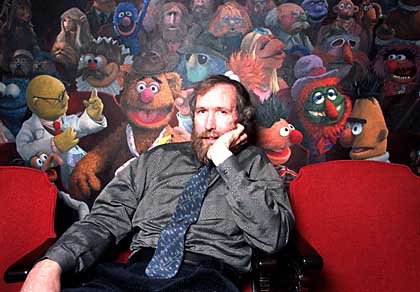
Creator of the Muppets Jim Henson poses in his 69th Street office in New York City on Dec. 30, 1985. (AP Photo/Burnett)
Welcome to my quixotic Muppet blog! Why don’t I get things started by answering some questions that you, the reader, may or may not be wondering:
Who am I? My name is Mary Arlene, sometimes spelled Arline–it’s a long story (see below). For more information about me, please click here.
What is my quest? Okay, at this point I’m not sure if that’s a serious question or if you–hypothetical reader–are just quoting Monty Python at me. But it doesn’t matter, because my answer is the same either way.
My quest–specifically as a Muppet blogger, but also generally as a human being–can best be expressed by the lyrics to the song “The Impossible Dream” from the musical Man of La Mancha. I’d like to pull out a few lines that I find particularly pertinent to what I’m trying to accomplish here:
“To dream the impossible dream / to fight the unbeatable foe / to bear with unbearable sorrow … to right the unrightable wrong … to fight for the right without question or pause / to be willing to march into hell for a heavenly cause.”
Why a Muppet blog? I used to write about Muppets a lot on my other blog. Eventually, one of my friends–perhaps growing tired of my preoccupation–suggested that I start a dedicated Muppet blog. It sounded like a fun idea. Because of my background, I believed then–as I believe now–that I have a unique fan perspective on the Muppets that would provide an interesting counterpoint to the other Muppet fan sites that are out there. (See also “Why do I call myself a ‘Muppet Heretic'” below.) But what with one thing and another, I never got around to it.
However, with recent schism (hereafter to be known as “the Schism”) between the Disney-owned Muppet Studios and longtime puppeteer Steve Whitmire, and the subsequent smear campaign waged in the press against Steve Whitmire, I felt the need to do my part to show my support for Steve and try to counteract all the negativity being directed toward him, both in the press and among the fan community.
Why do I call myself a “Muppet Heretic”? Partly because it fits in with my Don Quixote/Man of La Mancha theme, but it’s an idea that dates all the way back to when I first considered starting a Muppet blog in 2013.
To truly understand why I call myself a “Muppet Heretic,” you have to understand something about my background.
I was born in 1980, at the peak of Muppet mania. I’ve been a Muppet fan all my life, but during my formative years, I had limited access to them. When The Muppet Movie was released in theaters, I was not yet born. When The Muppet Show was wrapping up, I was still an infant. And although I was just the right age for Fraggle Rock when it premiered in 1983, my family could not afford cable, so as a kid, I knew the Fraggle characters mostly from the Weekly Reader series of picture books to which we somehow obtained a subscription–which I enjoyed very much but, to paraphrase Billy Joel, you can’t get the sound from a story in a picture book, aimed at your average kid. My first exposure to the Muppets was from Sesame Street, because it was available for free over the air; therefore, it was Sesame Street that really shaped my concept of what the Muppets were.
My secondary exposure to the Muppets was from the movies, but they weren’t readily available to me at first, either. We did go see The Muppets Take Manhattan in the theater when I was four years old, but in retrospect, I think I was too young for it. I got bored halfway through and turned around in my seat to watch the light from the projector–which is just as well, because if I had been paying attention when Kermit gets hit by a car, I don’t think I would have ever recovered. Eventually, I had access to the Muppet movies through home video, but I think it was 1986 before we could afford to buy a VCR. (And the first video we ever rented was Sesame Street Presents: Follow That Bird.)
So my experience with the Muppets was different from that of the typical Muppet fan my age. For example, I knew all the words to “The Rainbow Connection” before I even knew that there WAS a Muppet Movie, because my older siblings knew it and used to sing it to me all the time, long before I ever got a chance to see the film. As another example, I was 33 years old before I ever got to see Fraggle Rock in its entirety, although I had seen one episode at a friend’s house when I was six or seven.
While I’ve been a Muppet fan all my life, I only became involved in the online Muppet fan community around 2011 or so. And on becoming involved, I came to the uncomfortable realization that my Muppet fan opinions seem to be out of step with the mainstream Muppet fandom. For example, I think Sesame Street is funnier than The Muppet Show. I like Muppet Treasure Island more than I like The Muppet Christmas Carol (which is not to say that I think Treasure Island is better, per se; just that I find it more enjoyable). I like Muppets from Space more than I like The Muppets Take Manhattan (which has as much to do with the happy memories I have of watching Muppets from Space with friends in college than anything having to do with the movie itself). I like The Dark Crystal more than Labyrinth. I don’t have a single problem with A Very Merry Muppet Christmas Movie that I don’t also have with the original, non-Muppet It’s a Wonderful Life. And I tend to be less critical and more forgiving of post-Jim Henson Muppet projects than ones in which Jim was actually involved.
These are relatively minor Muppet heresies. I committed to a more major one in the summer of 2017. For 27 years prior to that, I believed–as most people probably did, and do–that Jim Henson’s children were the best qualified to represent his posthumous wishes. I no longer believe that.
I first began to have doubts when the Muppets were sold to Disney in 2004. This seemed like a terrible idea to me, but on the other hand, I know that Jim was in the process of selling his company to Disney when he died, so I was willing to give the Henson children the benefit of the doubt that they honestly believed they were going along with what Jim would have wanted.
But the final straw came in July 2017 when the Henson children sided with Disney and against Steve Whitmire in the Schism. Whether this was a coordinated effort between Disney and the Hensons, or Disney was just exploiting the Hensons for its own gain, I don’t know–but it certainly had the effect desired by Disney of discrediting Steve. After a bit of soul-searching, wherein I tried to look at the matter from every angle and think about not just what was said but how it was said, I lost all faith in the Hensons’ good intentions.
What can you expect to find on this blog? My primary purpose in this blog is to provide analysis and commentary on Muppet and Henson-related projects, both past and present. I have some ideas for regular article series that I would like to feature. For example, in 2013 I had a project on my other blog that I called “Year of Bert & Ernie,” wherein I posted a Bert & Ernie sketch every weekday. Since that time, the official Sesame Street website has been overhauled and most of my links are now dead, and I’d like to rebuild that archive if at all possible. I’d like to implement “Fraggle Fridays” wherein I give my impressions on Fraggle Rock from the perspective of someone who only got to see it as an adult. I’d like to analyze salient themes within Jim Henson’s body of work, and I’d like to explore my Muppet heresies in more detail.
My secondary purpose in this blog is to analyze the Schism objectively, to explore my feelings about it subjectively, to expand upon ideas that were too long and detailed to express as comments in Steve’s blog, to hold Disney and the Hensons accountable for their words and actions, and–as noted above–to show my unequivocal support for Steve Whitmire and do my small part to try to counteract all the negativity against him.
What can you NOT expect to see on this blog?
You cannot expect to see interviews with Muppets/Muppet performers. Given my unabashedly critical stance with regard to both Disney and JHC, it is extremely unlikely that they will allow me to speak directly or indirectly with any of the Muppet characters or performers. ToughPigs and The Muppet Mindset have some good interviews; if that’s what you’re looking for, I recommend you check those out.
You cannot contact Steve Whitmire or gain contact information for him from this blog. I’m just a fan of Steve’s; I’m not affiliated with him, have never met him, and only know him through his blog and his work with the Muppets. I don’t have his contact information, and I wouldn’t give it out even if I did.
You will not see undue criticism of, or personal attacks against, Matt Vogel and/or the other Muppet performers. Matt Vogel is a talented puppeteer. I have tremendous respect for him. What’s happening now with the Muppet Studios is not his fault. The same goes for the other Muppet performers. They have enough to worry about without me, or anyone else, sitting on the sidelines telling them how to do their jobs. I will treat them with nothing less than the respect they deserve, and I will hold all readers/commenters to the same standard.
Don’t expect to see spamming, flaming, trolling, or bullying of any kind. Let me make one thing perfectly clear: Commenting on my blog, or anyone else’s, is a privilege–NOT a right. If this privilege is abused on my blog, it will be suspended with or without advance notice and with or without explanation. Respectful disagreement will be tolerated; rude, inappropriate, or hateful comments will not. YOU HAVE BEEN WARNED!!!
Is my name spelled “Arlene” or “Arline”? At this point, either spelling is acceptable.
“Arlene” is actually my middle name; per my birth certificate, it is spelled A-R-L-E-N-E. I was named for my grandmother, whose middle name was “Arline”–pronounced the same, but spelled differently. My parents changed the spelling of my name to give me my own sense of identity.
When I started getting serious about blogging about ten years ago, I wanted a screen name that sounded professional and felt like it belonged to me. I hit upon the idea of using my middle name as though it were my last name. In honor of my grandmother, I decided to use her spelling of “Arline.”
When Steve Whitmire started his blog, and I started commenting on it, I decided to go back to spelling my name “Arlene” for the purpose. After all the joy he’s given me over the years as a Muppet performer, I wanted to make a gift of my true name to him. Unfortunately, I didn’t take into consideration that I would also be making a gift of my true name to everyone else who reads it. Oops. Ultimately, I’m glad that I made Steve a gift of my true name, because it made it all the more special when he quoted a comment of mine in one of his blog posts. 😀
When I decided to start this blog, I decided–in the interest of consistency with my comments on Steve’s blog–to tie my true name to it instead of using my grandmother’s spelling, as I have done elsewhere on the Web. Alas, when I was choosing a user name, I found that “maryarlene” was already taken, so I was forced to use “maryarline”. *sigh*
Why a Muppet blog NOW? With all the terrible things going on in the world, am I really worried about the integrity of a bunch of puppets?
Frankly, yes. Let me explain:
In the first place, I think what’s happening in the Muppet world right now is a sort of microcosm of what’s happening in the nation and the world at large. I think the same forces that led to Steve Whitmire’s dismissal from the Muppets–corporate greed, lack of accountability, and victim-blaming propaganda–are the same forces have caused a lot of the problems going on in the larger world at the moment.
In the second place, what happens to the Muppets matters…because the Muppets are a force for good in the world, and I’m sure we can all agree the world needs all the forces for good that it can get. Jim Henson once identified one of his business objectives as “work for [the] common good of all mankind.” Even Fraggle Rock, that cute little TV show for kids, that delightfully silly, lighthearted, whimsical, colorful, musical romp, was created for the express purpose of bringing about world peace. Jim Henson never did anything without a larger and more meaningful purpose behind it, and that purpose is still meaningful today–arguably more so than ever.
In the third place, none of us can vanquish all the evils in this world singlehandedly; if we try, we just tire ourselves out. We each have to pick our battles. We each need to go where we can do the most good. We each need to invest our talents where they will be the most useful and produce the best return.
In Steve Whitmire, I see a good man who has been the victim of a grave injustice. While he should be praised and honored for taking a principled stance and speaking out against a corrupt corporation, he has instead been bullied, harassed, and unjustly persecuted. When I look at the Muppet community as a whole, I see an alarming number of his so-called “fans” turning against him while people who really ought to know better turn a blind eye and a deaf ear.


 Frog of La Mancha