Alexander Hamilton, Jim Henson, and the Core Principles

“Hamilton had now written 60,000 words in just a couple of months.  For perspective, the book you are holding clocks in at 58,000 words and, I’m embarrassed to say, took much longer.”
                     –Jeff Wilser, “Seek the Core Principles,” Alexander Hamilton’s Guide to Life.

From November 1774 to February 1775, teenaged college student Alexander Hamilton wrote two political pamphlets defending the American Revolutionary cause.  Specifically, he was responding to pamphlets written by British loyalist Samuel Seabury.  While Wilser estimates Hamilton’s word count for the two pamphlets to be 60,000, according to my estimation, it is closer to 65,000.

I mention this because I was looking at my statistics page for this blog and found that over the course of five months, from July 31 to December 31, 2017, I wrote 66,089 words on this blog.  So I’m almost keeping pace with Alexander Hamilton, in quantity if not in quality.

I was feeling quite smug about this until I did the math and realized that–depending on whether the 60,000 or 65,000 word figure is more accurate–Hamilton still outstrips me by approximately 3000 to 4000 words a month because he created his content in a shorter amount of time.  Also, he was writing everything out in longhand and didn’t have the Internet to assist him in research.

Continue reading

Poison Tree

alternate Poison Tree (no text)

I was angry with my friend:
I told my wrath, my wrath did end.
I was angry with my foe:
I told it not, my wrath did grow.

And I watered it in fears
Night and morning with my tears,
And I sunned it with smiles
And with soft deceitful wiles.

And it grew both day and night,
Till it bore an apple bright,
And my foe beheld it shine,
And he knew that it was mine,–

And into my garden stole
When the night had veiled the pole;
In the morning, glad, I see
My foe outstretched beneath the tree.
                                                               –William Blake

I remember first reading this poem in high school and being horrified by it, because the anger and resentment that the speaker harbors not only poisons the speaker’s foe, it also poisons the speaker, to the point that the speaker is “glad” to see his (her?) foe lying dead on the ground.

I never want to be that kind of person.  I decided a long time ago that I would try never to derive pleasure from another human being’s misfortune.  I don’t always succeed, but I do try.

Continue reading

Twelve Days of Muppet Christmas/Epiphany 2018: “The Christmas Toy”–Allegory versus Applicability

DANNY HORN:  Hey, did I ever tell you about my theory that Mew’s death is a metaphor for AIDS? It’s 1986, and gay men are dying all over the place. The creators are TV puppet people from New York and LA, so obviously a lot of their friends are dying. So in this special, you get Mew — the despised, unfairly judged cat-toy — dying suddenly. Rugby realizes how precious Mew is… but he figures it out too late. […] Then the fantasy is that the dead loved one can be resurrected and vindicated, just through the power of love and Christmas. You can see how this was an appealing fantasy for artsy people in 1986.
KYNAN BARKER:  Did I ever tell you MY theory that sometimes a kids’ TV special is just a kids’ TV special?

–ToughPigs.com, “My Week with Another Christmas – Day Two: Doll Be Home for Christmas,”  December 24, 2003.

Today is Epiphany, so I wanted to do not only a Christmas-themed article but one with some real substance to it, and this 14-year-old conversation about The Christmas Toy is a good jumping-off point for a discussion of allegory versus applicability.

An allegory is a detailed, in-depth metaphor that represents a situation or event in the real world.  Authors who write allegory are usually not very subtle about the point they’re trying to get across.  For example, I would consider A Christmas Carol to be an allegory:  There’s not much to speculate about what the three spirits represent; it’s right there in their names.

On the other hand, a work has applicability if it can support multiple interpretations, regardless of what the author’s intention may have been.  As J.R.R. Tolkien explained it, “I think that many confuse ‘applicability’ with ‘allegory’; but one resides in the freedom of the reader, and the other resides in the purposed domination of the author.”  Tolkien ran up against this attitude often when Lord of the Rings fans would ask him questions about the allegorical meaning of the novels, to which he would respond that there was none, but that it was applicable to many real-life situations or events.

Continue reading

Doubting the existence of the Great Bell

“WHAT?!?  The cave is…is empty!  There is no bell!  It’s all a lie!”
–Gobo Fraggle, who apparently never thought to look up to see if there was a clapper in the ceiling of the bell-shaped cavern.

In starting a Muppet blog, my goal was to try to strike a balance between the serious and the silly, as the Muppets have always done so effectively.  While I’m still proud of the content I have created, I do feel that perhaps I’ve been less than successful in that regard.

I hoped that Christmas would be a time that I could lean more toward the lighthearted side of the spectrum, back off a bit from the Schism, and temporarily beat my sword back into a ploughshare.

(Although you don’t want to try plowing this time of year; at least in this hemisphere, the ground is frozen.)

Throughout this month, I’ve been watching Muppet Christmas productions in preparation for an article series that I see now that I’m not going to have time to do properly until next year.  However, instead of being a temporary respite from the Schism, they reminded me of it all the more, especially the productions made subsequent to 1990.

Continue reading

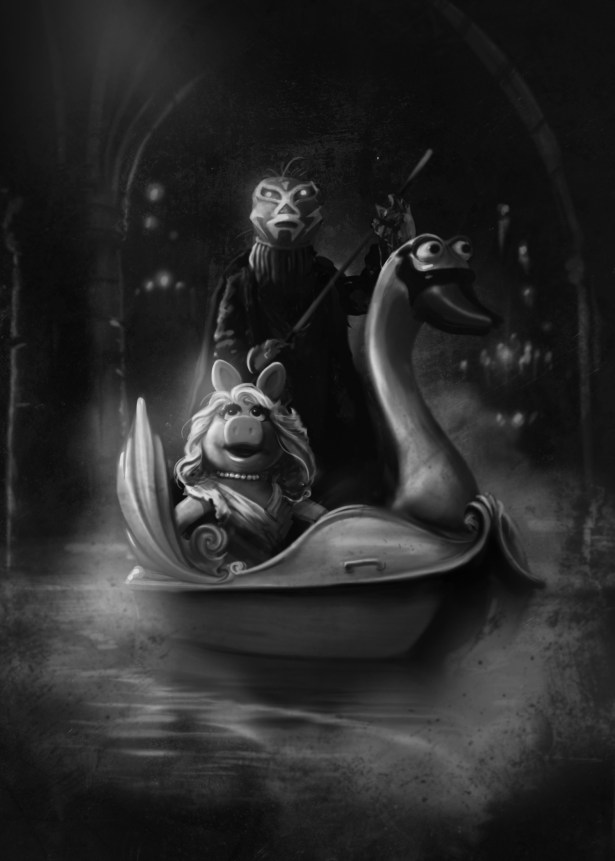
Phantom of the Opera: Everything’s better with Muppets

phantom5


Faust, a five-act grand opera, is by Charles Gounod with a French libretto by Jules Barbier and Michel Carré.  It is loosely based on Faust, Part I, by Johann Wolfgang von Goethe.  Goethe’s lesser-known follow-up, 2 Faust 2 Furious, focused on a man who made a deal with the diesel.”

–Erik Forrest Jackson, pushing all my geeky English-major buttons in an explanatory footnote of Muppets Meet the Classics: The Phantom of the Opera

When I opened the book and saw that the epigraph was a quote from a renowned French philosopher and a line from an old infomercial, I knew I was going to like this book.

When I started laughing hysterically at the table of contents, I knew I was going to love this book.

When I finished reading it, I wanted to go back and read the original novel again to compare the two; the mark of a good book is that it makes you want to read more.

Continue reading

The ‘Phantom of the Opera’ is here…

…inside my house!

*dramatic organ music*

Remember when I entered a contest by The Muppet Mindset in which I drew a picture of Walter as Harry Potter and somehow won a copy of a free Muppet book, even though Walter looks like he only has one arm and the rampant Gryffindor lion on his Hogwarts insignia looks more like E.T.?*

Well, my 15 minutes of sketching and two months of patience have finally paid off, because today went to the mailbox (for the first time in the better part of a week) and received my Muppetized version of Phantom of the Opera!

YAY!

Before I forget, a big thank you to Jarrod Fairclough and Mitchell Stein at The Muppet Mindset for hosting fun contests and giving out free stuff, and specifically for their very generous assessment of my drawing.

Even more fortuitously, I have today, tomorrow, and most of next week off from my part-time job, so I really have nothing to do in those evenings except read.  So I’ll go start it now, and when I finish, I’ll come back and tell you what I thought about it.

In the meantime, give yourselves in to the “Music of the Night”:

______________________
*Although I am proud of one subtle Muppet reference that I put in there: the Ravenclaw crest is supposed to be a bronze eagle on a blue background, but I made the background bronze and the eagle blue as an homage to Sam the Eagle.  “Is nothing sacred?”

Creativity

“Do something creative because you can’t NOT do it.”
–Kermit the Frog

Last week or so I was in a morbid mood, indulging in my self-defeat and wallowing in self-pity as I looked at my life:  Working two jobs to make ends meet, which sucks up all the time I’d rather be spending on researching and writing.  One job transcribing/editing other people’s words instead of writing my own; the other job working in retail, making me feel like I’ve come full circle and ended up right back where I started in high school, as though all my education and training and experience and suffering over the past 20 years has all been for naught.

Desperately in need of some inspiration, I turned back to Kermit’s TED talk from 2015, and that was very helpful.  One part was particularly helpful, and you know how much I love to take other people’s/frogs’ words and put them into big block quotes, so here goes:

“We need to help kids–and all of us trying to connect with our inner tadpole–to pursue our passion, even when the going gets tough.  Now, for grown-ups, that just might mean, folks, you gotta have a day job.  Cuz let’s face it, it’s easier to take creative chances when it’s not how you’re trying to support yourself.  That can be tough.”

That made me feel better about taking the second job.  No shame in doing what it takes to survive, so long as you don’t hurt others in the process.  And if that means I have to try to bang out part of a blog post in the time between stopping one job for the day and starting another, then I guess that’s what it takes.  It’s not ideal–it’s not at all the way that I prefer to work–but if that’s what the situation calls for, then I’ll just have to be flexible and learn to adapt, which is a professional skill on which I have always prided myself.

Continue reading

Fraggle Friday: Episode 102–“Wembley and the Gorgs”

“The Gorgs might be the bullies at school, but they might also be a mean boss, or an abusive boyfriend, or the Taliban. It’s a good thing we have Fraggle Rock, to help us figure it out. For all we know, there might be Gorgs everywhere.”
 –Danny Horn, “My Week with Fraggle Rock, Part 2: Big Shots,” ToughPigs.com, November 4, 2004.

I’ve wanted to write about this episode of Fraggle Rock for four years now, long before I had a Muppet blog, and long before the Schism.  I hope I can do it justice.

Let’s start things off with a song.  Take it, Wembley:

This song plays a relatively minor role in the episode, but I wanted to highlight it because it is one of my very favorite Wembley songs.  Steve’s voice here is like a soft, cozy blanket–warm and fuzzy and friendly.  Which, come to think about it, is a good description of Wembley’s character in a nutshell.

Now, instead of looking at the episode chronologically, let’s jump around and look at it thematically.  To that end, let’s get started at the end of this episode, in which Wembley makes a very profound statement: “I guess some slavery feels like freedom.”

Continue reading

Thanksgiving

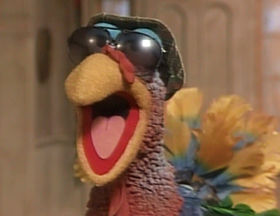
Character.chistmasturkey

Happy Thanksgiving, everyone!  I know the holiday is not really a thing outside the U.S. and Canada (and in Canada it happened a month ago), but there’s never a bad time to be grateful for the good things in our lives, especially when the bad things threaten to overwhelm us.

Thank you especially to Steve Whitmire, for teaching us (back in 1987) that turkeys are selfish, ungrateful bastards and that we should eat them, because if we don’t, they will conspire to murder Big Bird. 😉

Seriously, though…

Continue reading

Sesame Saturday: Sesame Street Trumps Donald Trump

“There is one source that has always recognized Trump for being the absolute villain that he obviously is and that’s Sesame Street. Sesame Street has been touting the dangers of a Trump Presidency since the late eighties!”
 –Louie Pearlman, “Make America HATE Again: Ronald Grump on Sesame Street,” ToughPigs.com, January 29, 2016.

This is an excellent article that appeared on ToughPigs just before the 2016 primaries…so, almost two years ago?  Oh, how time flies when you’re in constant mortal dread for the future of humanity!  Anyway, the article is well worth a read, but I had a few thoughts to add from the perspective of being almost a year into the Orange Muggle Voldemort presidency.

Continue reading

“We will march against the mighty; we will march against the strong”

“Why are you wasting your time with those puppets?” asked Rudy Pugliese, one of Jim Henson’s college professors.

I sometimes hear a similar question in my head: “Our democracy is imperiled, our Constitution is in crisis; why are you wasting your time worrying about the integrity of a bunch of puppets?”

To which the short answer is, in the words of Cantus, “No time is wasted time.”

Yes, the Muppets are puppets; that is undeniable, and it would be pointless and silly of me to argue otherwise.  But they are so much more than that.  They are symbols; they are fuzzy mirrors in which we see our own flaws and foibles reflected; they are useful rhetorical tools with which one can make subtle arguments against injustice and demagoguery in a nonthreatening way.  In the words of Steve Whitmire, “These characters stand for all of us, and we’re worth defending.” (my emphasis)

Continue reading

It’s Not Easy Being the Last Jedi

You don’t want to admit how possessive you’ve become [of Luke Skywalker]. There are times where you go, ‘Really? That’s what they think of Luke? I’m not only in disagreement‚ I’m insulted.’ But that’s the process and you thrash it all out.”
                            —Mark Hamill

Watch your back, Mark.  Star Wars is a Disney property now, and at Disney, nothing is sacred, everyone is expendable, and expressing opinions about a character you’ve played and/or been associated with for decades is considered “unacceptable business conduct.”  If Kermit the flippin’ Frog is fair game, so is Luke Skywalker.

(Also of interest is the original New York Times article in which the above quotation originally appeared.)


What Would Walt Disney Do?

(or “WWWDD?”)

I think I was about seven years old when I learned that “Walt Disney” was the name of an actual person.  Prior to that point, I assumed that it was just a meaningless, made up brandname, like “Kodak.”  I bring that up because it seems to me that a lot of people, even–and perhaps especially–those who work for the company itself, sometimes forget that there was a real person behind the name, a man behind the mouse.

Continue reading

Emperor Disney Has No Clothes; or, Attempting to Strike While the Iron Is Hot

I intended (and still intend) to write my own review of Vogel!Kermit’s appearance on Dancing with the Stars on Monday, but I was waiting until I had a chance to talk to my mom about it, because I suspect that she will give me a good sound bite to turn into an opening quote.

But I’m just now hearing about the negative reaction to the appearance on Twitter from the casual Muppet fans, and it is strange and wonderful.

(Here’s the link.  Just watch the video.  Don’t read the little story underneath it; it’s unnecessarily snide and hurtful.)

It’s strange (and a little frustrating) because this issue has consumed my life for three months now, so to see other people just cottoning on now kind of makes me want to scream “Where have you BEEN for the last three months?!?”  But it would be hugely hypocritical of me if I were to scream that because (a) prior to when the news broke in July, Muppets had been a fairly low priority for me and (b) I’m the woman who came 30 years late to the Fraggle party; I can hardly criticize anyone for being a measly three months behind the times.

On the other hand, after three months of rationalizing and justifying from the mainstream Muppet fandom–all the walking on eggshells on the big-name fansites for fear of pissing off Disney–and Tom Bergeron et al. on the show itself pretending that everything is normal, it’s so refreshing to hear people outside of our little die-hard circle of Steve’s loyal fans candidly speak up, like the child in The Emperor’s New Clothes, and say, “What the hell is going on?  That doesn’t sound like Kermit at all!”

I’ve never considered myself a Jeanne D’Arc, and it doesn’t come naturally to make a call to figurative arms, but now might be an opportune moment to try and get the word out about what we know to be true about Steve and Disney.  Now might be a good time to write more letters to the Disney execs.  Now might be a good time to start re-circulating the petition.  Now might be a good time to start talking to the casual fans about our concerns.

At the very least, we should try to gently persuade them to direct their anger where it belongs, toward the suits at Disney and the Muppet Studios, and try to deflect their anger away from Matt.

The mainstream Muppet fandom seems to have largely turned its back on both Steve and us, so now might be a good time to get the word out, to try to evoke some epiphanies in the casual fans, perhaps spur them to some kind of action, but at the very least, bring them into the conversation.

(And for me, it starts on Saturday when I’m going to a Halloween party dressed “sort of approximately” like Kermit.)